


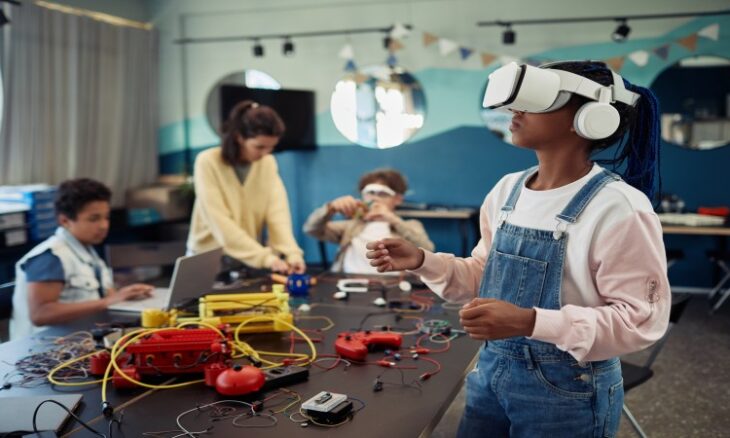
AR Smart Glasses Improve STEM Classroom Involvement
Flinders University researchers found that AR smart glasses increased engagement during science lessons in an Australian primary school. The technology also supported collaborative learning among young students.
The research examined the use of an augmented reality Interactive Visual Learning Environment (AR-IVLE) in a Victorian primary school. The trial involved 84 students of Year 1 and Year 2 and five teachers. Researchers used the project to assess how effectively young children engaged with the learning process while using the technology in a classroom environment.
The study was carried out by education researchers from Flinders University, the Australian Catholic University and Zhejiang Normal University in China. The findings were published in the Journal of Science Education and Technology.
The AR smart glasses were used alongside iPads and Apple TVs during classroom activities. The connected system enabled pupils and teachers to share digital content and observe the same material simultaneously throughout lessons. Researchers reported that the approach encouraged collaborative learning and supported group participation during teaching activities.
The study focused on lessons about ants and their nest-building communities. Researchers said this area of science can be difficult for young children to understand through conventional classroom instruction alone. The virtual learning environment enabled pupils to observe ant colonies in an interactive format that could be explored from different viewpoints within the classroom.
During the trial, teachers first gathered students together at the front of the classroom for whole-group instruction. Under teacher supervision, each pupil then used the AR smart glasses individually for approximately five to seven minutes. While one student used the glasses, the remaining students in the class observed the same activity on an iPad display connected to the system.
Researchers reported that this method enabled pupils who were not directly using the glasses to keep engaged with the lesson. The shared display enabled students to follow the hands-on learning activity in real time, observing actions and interactions inside the virtual environment.
Students wearing the AR smart glasses were able to walk around the classroom while examining the ants and nest structures from multiple angles. The pupils interacted with the virtual learning objects using hand gestures and zoom functions. Researchers observed students exploring different aspects of ant colonies as they moved throughout the room during the exercise.
At the same time, other pupils participating in the group activity were observed communicating verbally with classmates. Students gave directions to one another while identifying features within the virtual environment, including the queen ant, worker ants, male ants and nest chambers. Researchers said this group interaction formed part of the cooperative learning process observed during the study.
Observations from whole-class feedback meetings and follow-up assessments indicated that pupils using the immersive AR learning system showed higher engagement than those using conventional iPads or tablet devices. Researchers recorded stronger concentration, higher energy levels, greater creativity, and more active classroom participation during learning activities involving the AR smart glasses.
The study also reported improvements in learning outcomes during the science exercises. Researchers found that pupils demonstrated greater understanding of lesson material, produced richer ideas and showed stronger cognitive skills through classroom tasks and follow-up reflections connected to the activities.
Researchers also reported that pairing the AR smart glasses with iPads and classroom television displays during group exercises increased social engagement among pupils. The study found that students engaged in greater levels of collaboration through shared exploration, classroom discussion, and teamwork during the activities.
The researchers stated that further multisite studies across a wider range of early childhood settings and socio-economic contexts could help validate and extend the project’s findings. They also stated that longer-term studies with reduced researcher participation would be necessary to distinguish novelty effects from sustained engagement associated with the technology.